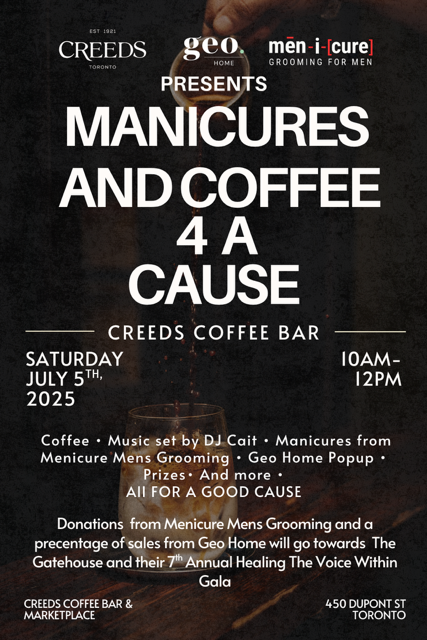
Manicures & Coffee 4 A Cause – A Morning of Self-Care and Social Impact in Toronto On Saturday, July 5th, 2025, join us at Creeds Coffee Bar for a unique community fundraiser: Manicures & Coffee 4 A Cause. This uplifting morning blends self-care, music, and mindful shopping — all in support of a powerful cause. 📍 Location: Creeds Coffee Bar, 450 Dupont Street, Toronto🕙 Time: 10:00 AM – 12:00 PM Presented by Creeds Coffee Bar, Geo Home, and Menicure Men’s Grooming, the event features: 💅☕ Whether you’re stopping by for a mid-morning pick-me-up or looking to connect with others who care about making a difference, this event is your invitation to relax, give back, and feel good doing it. Why This Event Matters Proceeds from the event will directly support The Gatehouse and its 7th Annual Healing the Voice Within Gala, a signature event dedicated to raising awareness and funds for adult survivors of childhood sexual abuse (CSA). About The Gatehouse: Transforming Trauma into Healing The Gatehouse is a Toronto-based charitable organization and registered nonprofit committed to providing a safe, inclusive space for adult survivors of childhood sexual abuse. Located in a historic house near the shores of Lake Ontario, The Gatehouse offers peer support, expressive arts therapy, and community education programming that empowers survivors to reclaim their voices and rebuild their lives. Since its founding, The Gatehouse has served over 20,000 people through a trauma-informed, peer-led approach. Their programs are non-clinical, survivor-directed, and deeply relational, creating meaningful pathways to healing that honour lived experience. The organization is nationally recognized for its innovation in survivor-led peer support, and its model has been replicated in other parts of Canada and internationally. Programs include: Learn more at thegatehouse.org Join Us & Be Part of the Healing Manicures & Coffee 4 A Cause is more than just a Saturday morning hangout — it’s an opportunity to contribute to a community of healing, advocacy, and support. When you sip a coffee, get a manicure, or pick up something special from the Geo Home pop-up, you’re helping survivors access safe spaces, compassionate peer connections, and meaningful healing experiences. Your presence helps amplify the voices of survivors, reduce stigma, and raise vital funds for The Gatehouse’s mission. Let’s Make Healing Visible Come as you are. Bring a friend. Invite others. Let’s come together to create impact — one manicure, one coffee, and one conversation at a time. 🖤 Together, we can make healing visible. Check out Creeds Coffee https://creeds.com/?srsltid=AfmBOopT5us_y_ULgLZs6numgPY-N8TkYeZSyNUXIb62IbtulgYdYuul Event Contact Lorne M. Simon @ SimonMCPR lornesimon@icloud.com
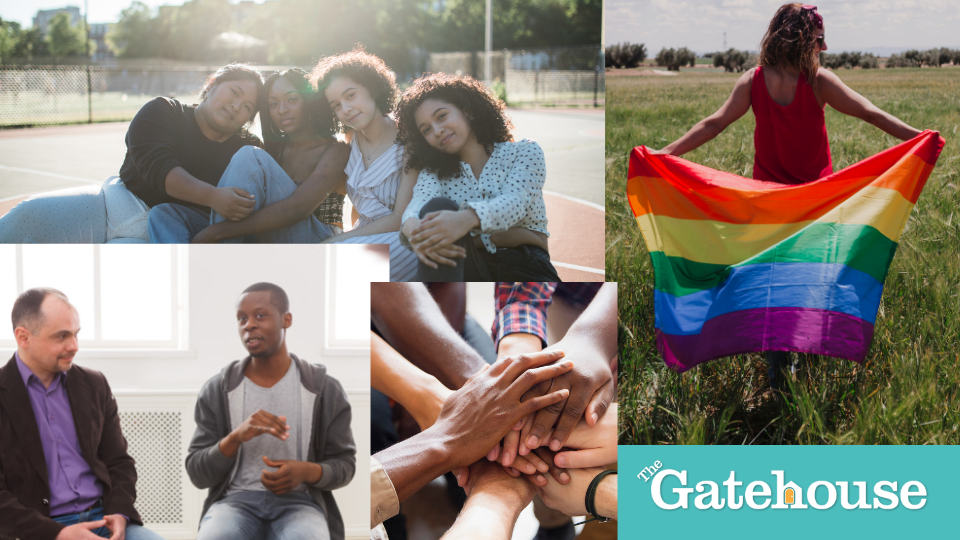
Peer Support Program for 2SLGBTQIA+ CSA Survivors : Compelling Evidence of Program Effectiveness
The Gatehouse was proud to collaborate with senior students from Humber Polytechnic’s Community Development program on a research project examining the effectiveness of our Phase 1 peer support program for 2SLGBTQIA+ adult survivors of childhood sexual abuse. This partnership provided valuable insights into both the strengths of our existing services and the unique needs of 2SLGBTQIA+ participants within our community. As part of our commitment to continuous improvement and inclusivity, The Gatehouse is actively taking steps to implement the report’s key recommendations. We will be hosting a focus group with 2SLGBTQIA+ survivors to gain a deeper understanding of their experiences and needs. Additionally, we are updating our training resources and program materials to ensure greater representation, inclusive language, and identity-affirming practices across all levels of our service delivery. This collaboration reflects our ongoing dedication to creating safe, responsive, and empowering spaces for all survivors, especially those from communities that continue to face systemic barriers in accessing support. 2SLGBTQIA+ Peer Support Program Survey Snapshot 18 participants surveyed; diverse gender identities and sexual orientations. 33.3% said they would prefer a 2SLGBTQIA+-specific group;50% preferred mixed groups;16.7% were unsure. 58% said they did not receive follow-up resources or aftercare information. 78% made suggestions for increased inclusion, even if they felt generally supported. Peer Support Group Program Recommendations for Improvement The full report can be accessed —>Final Research Report (1) The Gatehouse remains deeply committed to providing trauma-informed, inclusive, and empowering peer support to all survivors of childhood sexual abuse. This collaborative research project with Humber Polytechnic students has highlighted both the meaningful impact of our programs and the opportunity to evolve further by addressing the unique needs of 2SLGBTQIA+ participants. By listening to survivor voices, reflecting on lived experiences, and embracing recommendations grounded in intersectionality and equity, we are taking actionable steps toward fostering safer, more representative spaces. The upcoming focus group, updates to facilitator training, and the integration of 2SLGBTQIA+-inclusive content into program materials are just the beginning. We are grateful to the participants, student researchers, and our wider community for their trust and insight. Together, we continue to build a future where every survivor feels seen, supported, and empowered in their healing journey. Thank you to the Humber Polytechnic student team for their invaluable work on this! If you are a 2SLGBTQIA+ community member who took part in a Gatehouse phase 1 program in the past and would like to submit feedback about your experience, please contact: Karen MacKeigan, Program Coordinator, Intakes & Phase 1, via email at karen@thegatehouse.org This research is critical in addressing a long-standing gap in literature and practice surrounding the experiences of 2SLGBTQIA+ survivors of childhood sexual abuse (CSA) in peer support settings. Members of the 2SLGBTQIA+ community face disproportionately high rates of CSA and often experience additional barriers to accessing affirming, inclusive support. By centring their voices and lived experiences, this research highlights the need for trauma-informed, identity-affirming approaches that recognize and respond to the intersectional realities of gender, sexuality, race, and survivorship. The findings offer practical insights that can enhance program responsiveness, increase participant safety and comfort, and ensure that healing environments like The Gatehouse remain welcoming and effective for all survivors. The Gatehouse is a registered Canadian charity dedicated to providing peer support, education, and healing spaces for adult survivors of childhood sexual abuse. Our work is made possible through the generosity of donors, volunteers, and community partners. To support our efforts, you can make a donation, volunteer your time, sponsor a program or event, or share our mission with others. Every contribution helps us continue building safe, inclusive spaces where survivors, especially those from underserved communities like 2SLGBTQIA+, can be heard, supported, and empowered. Learn more or get involved by visiting www.thegatehouse.org/donate. Google Form Feedback Survey We’ve already hosted two focus groups to learn what you want in a support group, and now, we’re inviting even more voices to help shape this program. Are you or someone you know a 2SLGBTQIA+ survivor seeking peer support? Your input matters. Please take a moment to complete our short survey by Friday, July 25, 2025. Click the link to share your thoughts! https://docs.google.com/forms/d/e/1FAIpQLSd_dJnl2-sxRZUovIYlAmP0rwfJ-5SKrG3470eNsGbJIMKMkg/viewform?embedded=true Another great resource for 2SLGBTQIA+ support can be found here: https://www.the519.org/
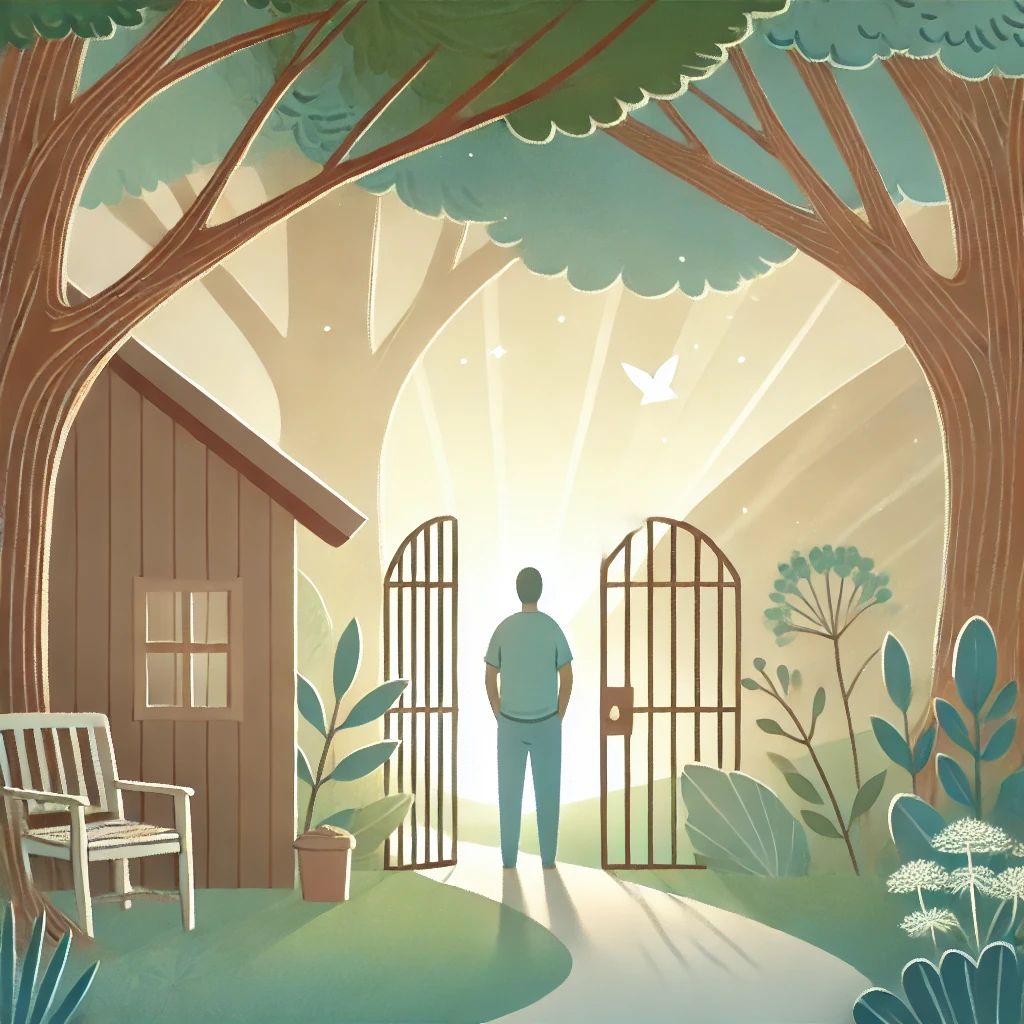
Health is Wealth: Invest in Yourself as a CSA Survivor
As survivors of childhood sexual abuse (CSA), many of us have spent years carrying burdens we did not choose. Healing can feel like a long and uncertain journey—but it’s important to remember this: your health is your greatest wealth. The investment you make in your emotional, physical, and mental well-being is one of the most valuable gifts you can give yourself. Survivors often put others first or avoid their own needs, but healing starts when you decide that you matter, that your well-being deserves attention and care. Just as we might save for the future or invest in our careers, we must also prioritize ourselves by tending to the wounds we carry. Your story, your body, your emotions—they all deserve nurturing, safety, and space to heal. Investing in Yourself Looks Like: A Commitment to Personal Growth and Self-Improvement At The Gatehouse, we offer a supportive, non-judgmental space for adult survivors of CSA to begin or continue this journey. You don’t have to do this by yourself. Whether it’s through our peer support programs, workshops, or survivor-led initiatives, there are compassionate people here to walk beside you. Your healing is an investment in your future—your peace, your relationships, your sense of purpose. Every step you take toward wellness is a step toward reclaiming your voice and your life. Visit thegatehouse.org to learn more about how we can support you. Because you are worthy of healing.Because health is wealth.Because you matter.
Healing with Expressive Art Therapy
Art therapy can help survivors of childhood sexual abuse (CSA) express what words might not be able to. It’s about letting go of judgment and perfectionism, embracing the process, and creating simply for the joy of it. Expressive Art Therapy isn’t about making art for others, it’s about making art for yourself, to better understand yourself. And yes, that can feel vulnerable as it might stir up old emotions or unlock new ones. Expressive Art Therapy can also reconnect us with our inner child, bringing moments of pure joy. The expressive arts honour our deep longing to be seen, heard, felt and understood. We can use all the arts (visual art, voice, writing/poetry, dance/movement, drama and somatic) therapeutically to express ourselves in creative ways. Maybe art doesn’t feel intuitive to you, or maybe you don’t think of yourself as an artist. That’s okay. Let’s explore some creative activities that you can begin to explore at your own pace. Activity 1- Nature-based expression to move with grief or other emotions: Recall something from your life you would like to make peace with. You don’t need to be completely ready to make peace, you just need to be willing. Notice your willingness even if you are only a little willing and set your intention to begin this creative process to help you process, heal, let go and transform whatever it is that you are choosing to dedicate this practice to. On your walk, remember your intention. Look for flowers, grasses, leaves and especially things that nature is naturally letting go of. You may notice there are things you are drawn towards. Bring a small bag to collect anything that catches your eye. If you are taking small branches or flowers, remember to ask the plant for permission. Asking for permission recognizes that we live in reciprocity with nature. Once you have collected enough materials from nature (this can happen over a few days or weeks) you can set aside a day to start working with the materials you have gathered. Spread your gathered items on a piece of cloth, table, or floor and start to see how the materials want to be assembled. Feel free to use things from your home such as ribbons, colorful paper, and string to assemble the materials. You can assemble and work with the material in any way that allows you to be with and express the emotions you have been working with. Some people create a grief bundle or a bouquet. You can use paper or a canvas to glue the materials or make a 3-D structure. Something completely unique may want to emerge. Stay with the process and be with what you are experiencing. You can play music, light a candle, have a warm cup of tea or cacao and make this a healing ritual for yourself. You can come back to work on this over many days or you can create something in just one afternoon. Once your creation feels complete, you can be with it. Look at it and give voice to it. What would it say if it could speak to you? You can dance or move with it. You can keep this creation as long as you want, or you can return it to the earth or burn it in a fire. It is totally up to you. Notice and journal your process.
Breaking the Silence: Challenges Men Face in Speaking Out about CSA
Childhood sexual abuse (CSA) is a profoundly traumatic experience that leaves lasting impacts on survivors, regardless of gender. However, societal attitudes, stigmas, and misconceptions uniquely affect men who have experienced this form of trauma, often making it exceptionally difficult for them to come forward and seek help. Understanding these difficulties is essential to creating an environment where healing can truly begin. One of the greatest barriers men face when disclosing CSA is societal expectations rooted in gender norms. Men are often socialized to be strong, self-reliant, and emotionally resilient. From a young age, many boys learn that expressing vulnerability or admitting victimization is synonymous with weakness. This societal pressure contributes to a deep sense of shame and self-blame, discouraging men from speaking openly about their abuse. The stigma surrounding male victimization is prevalent and harmful in many ways. Society often holds stereotypical beliefs that men cannot be victims or that they must have somehow been complicit in their abuse. These harmful myths perpetuate feelings of isolation and self-doubt among male survivors, making them fear judgment, disbelief, or ridicule if they reveal their past experiences. Historically, support systems and resources for CSA survivors have been predominantly designed with female survivors in mind. While this attention is necessary and justified, it inadvertently leaves male survivors with fewer accessible services tailored to their specific needs. The lack of visible representation and acknowledgment can make men feel invisible or invalidated, further discouraging them from seeking help. Men who experience CSA often grapple with fears about how they will be perceived. Often, when men are coming forward to seek support at The Gatehouse, concerns about sexuality, masculinity, and identity frequently arise, creating internal conflicts and confusion. Many survivors worry that disclosure might lead others to question their sexual orientation or masculinity, leading to additional layers of anxiety and reluctance to speak out. Due to cultural conditioning, many men struggle to articulate emotions effectively. Childhood sexual abuse survivors often experience complex emotions like anger, guilt, and sadness. However, expressing these feelings can be challenging for men who have been discouraged from emotional openness. The lack of emotional vocabulary or fear of being overwhelmed by these feelings prevents many from engaging in therapeutic conversations essential for healing. Recognizing these barriers is the first step in fostering a supportive environment for male survivors of CSA. Encouraging open dialogue, raising public awareness, and developing male-specific support programs can significantly impact survivors’ willingness to seek help. It is essential to reinforce that vulnerability and strength are not mutually exclusive, and seeking help is a courageous act deserving of respect and empathy. The Gatehouse provides peer support groups for men, women, and all gender identities. Breaking the silence surrounding male childhood sexual abuse requires collective effort. By challenging harmful stereotypes, improving accessibility to resources, and promoting compassion and understanding, society can create safe spaces for male survivors to share their experiences and begin their healing journey. Every voice deserves to be heard, and every survivor deserves support, regardless of gender.
Finding Your People: How to Build a Support System That Truly Cares
Written by: Erin Alexandra When we experience childhood sexual abuse (CSA) trauma, shame and guilt can take hold, influencing our actions and shaping how we see ourselves. These emotions often lead CSA survivors to withdraw, making their worlds feel smaller while the voice of shame grows louder and more dominant. Connection, however, fosters healing: Community acts as the earth, air, sunshine, and rain—nourishing us so that, like plants, we can grow and thrive. In safe, supportive spaces, we see our best qualities reflected in us. Through connection, we find validation and affirmation, and over time, our choices become guided by joy and fulfillment rather than fear and self-doubt. How then, do we move from isolation to connection when shame and guilt foster distrust? How do we build a support system? What we focus on expands—so rather than scanning for red flags to avoid, let’s intentionally seek out green flags, the qualities in people and relationships that foster trust, and safety. Signs of Trustworthy Behaviour Trusting after trauma can be challenging, and it can take time. Sometimes, we need to re-learn to trust our instincts. These are a few green flags to look for in people to help you remember that you deserve to be treated with love and respect. Respect for Boundaries A trustworthy person understands and respects your boundaries without pushing, questioning, or making you feel guilty. They listen when you express your needs and never pressure you to go beyond your comfort level. Likewise, when someone sets boundaries with you, it’s not a rejection—it’s an effort to maintain a healthy and respectful relationship. (Acceptance of your boundary, they don’t punish you for the boundary, adhere to the boundary, and clarify any confusion around the boundary) Actions Align with Their Words The saying ‘actions speak louder than words’ is a cliché for a reason. It’s easy to say the right thing, but true integrity is shown through follow-through. When someone’s actions align with their words, it reflects not just honesty, but also respect—for themselves, for you, and for what they say. This consistency builds a foundation where trust can grow naturally Reliability For CSA survivors, reliability is more than just keeping promises—it’s about creating a sense of safety and stability in relationships. When someone repeatedly lets us down, it can reinforce the fear that trusting others will only lead to disappointment. A reliable person, however, demonstrates through their actions that they are consistent, trustworthy, and safe. For CSA survivors, a reliable person provides reassurance that not all relationships are unpredictable or unsafe. Over time, their consistency can help rebuild trust, making it easier to form connections without fear of abandonment or betrayal. This looks like: Respecting commitments, emotional consistency, taking responsibility, and respecting your space. Empathy For CSA survivors, empathy is more than just kindness—it’s a crucial sign of emotional safety. A person who exhibits empathy listens without judgment, acknowledges your feelings, and respects your experiences without trying to fix, question, or minimize them. They understand that healing is not a linear process, and that trust is built over time, not demanded. For CSA survivors, genuine empathy fosters a sense of safety and trust, making it easier to engage in relationships without fear of being judged or misunderstood. It reassures you that your feelings and experiences matter, allowing space for healing at your own pace. This looks like: Active Listening; emotional validation; support without pressure/understanding that you know what’s best for you Good Communication For CSA survivors, clear and honest communication is essential in building safe and trusting relationships. Not everyone finds communication easy, but a trustworthy person tries to express their thoughts and feelings in a way that is honest, respectful, and considerate of your experiences. Even if they struggle, they are willing to learn, listen, and improve, ensuring that misunderstandings don’t become barriers to connection. For CSA survivors, honest and compassionate communication fosters emotional safety, making it easier to trust that your voice matters and will be met with respect. This looks like: Speaking with honesty, not harm; listening to understand, not just respond; clarity and consistency; and willingness to grow. Supportive For CSA survivors, supportiveness is more than encouragement—it’s about creating a space to share your growth, struggles, and successes without fear of judgment, comparison, or competition. A truly supportive person uplifts and validates your experiences, celebrating your achievements wholeheartedly while understanding that your healing and progress do not take away from their own. For CSA survivors, true support fosters a sense of trust, safety, and belonging. It reinforces the belief that healing and success are not solitary journeys—we rise together, in relationships built on mutual respect, understanding, and encouragement. This looks like: They show up in triumphs and challenges; they encourage rather than overshadow; support is mutual and respectful. Compassionate Accountability For CSA survivors, accountability can be a deeply complex issue, especially when past experiences have linked mistakes with shame, punishment, or fear. In healthy relationships, accountability is not about blame or control—it’s about learning, repairing, and growing together in a way that fosters safety and trust. Compassionate accountability means acknowledging harm without reinforcing shame. When someone expresses their hurt while remaining open to working through the issue, they demonstrate both respect and trust. This creates space for honest conversations, where mistakes can be addressed without fear of rejection, abandonment, or emotional retaliation. For CSA survivors, compassionate accountability builds relationships rooted in trust and emotional safety. It allows for honesty without fear of abandonment and creates a culture where growth is nurtured through mutual care rather than fear or punishment. This looks like: Mistakes are opportunities for growth, not weapons for shame; Accountability fosters safety, not fear; Repair is prioritized over perfection; Boundaries and respect guide the process Healing doesn’t have to be a journey walked alone. If you or someone you know is a CSA survivor, we encourage you to reach out and connect. Whether it’s through a support group, a trusted friend, or The Gatehouse community, there is strength in togetherness. You
Transforming Trauma into Triumph Conference
15th Annual Transforming Trauma Into Triumph Conference Date: Wednesday, May 14, 2025 Time: 9:30 AM to 4:00 PM Location: Humber College Lake Shore Campus The one-day conference hosted speakers with lived experience and professionals in various fields, including psychotherapy, social work, film, poetry, education, law enforcement, and journalism. Conference participants range in backgrounds, from survivors of childhood sexual abuse to post-secondary students, social service professionals, police officers, and community members joining to learn how they can better interact with and support those traumatized by childhood sexual abuse. Read the event report -> 2025 Conference Summary Report Transforming Trauma Conference The Objectives of the Event: Increased awareness of the impact of childhood sexual abuse, the resiliency of survivors, Increased knowledge of available services in the communities that support CSA survivors. Knowledge sharing and dissemination of wide-ranging viewpoints from victimization to criminal justice to healing and recovery from trauma. Collaboration between psychotherapists, mental health practitioners, victims of human trafficking, and those who have experienced Childhood Sexual Abuse sharing their healing journeys. Why this event? 1 in 3 girls and 1 in 5 boys will be sexually assaulted at some time in their lives. The Gatehouse is a leader in the field of addressing childhood sexual abuse trauma. Survivors of sexual abuse are in desperate need of our support and services, and we rely on the generosity of individuals and businesses to fund and expand our programs. Survivors learn to regain their voice in peer support settings, which facilitate positive coping techniques to address the anxiety, nightmares, and depression resulting from childhood sexual abuse. This conference would not be possible without the collective effort of many. To our wonderful guest speakers and the dedicated Gatehouse staff, thank you for your passion and commitment. To our placement students, thank you for your hard work in helping set up and support today’s event—your contributions do not go unnoticed. A heartfelt thank you goes out to Erin Alexandra and Jasmine Lem for your wonderful efforts in helping with this event. Your vision, attention to detail, and commitment to excellence have helped bring this meaningful gathering to life. Thank you to Paula Cordeiro, Karen MacKeigan, Stewart Thompson, and our summer students who helped make this event a wonderful success including: Omid Ghafari, Hannah Rossi, Chi Yan Kwong, Avnie Agnihotri, Martha Sandoval, Nathalie Cousineau, Douglas Andrade, Riya Macwan, Stella Sarfo, Sreelakshmi Nadarajan, Sakshi Krishna, and Anna Antonova. Thank you to Humber College and your wonderful staff, Sonia Rodrigues, who helped coordinate the booking of space, and Katie Evans, Manager, Campus Dining & Retail Services and all catering staff. Questions? Contact: Erin Alexandra, erin@thegatehouse.org, Communications Assistant, The Gatehouse
The Transformative Power of Setting Goals for CSA Survivors
When you set goals, you’re doing more for yourself than you might realize. For CSA survivors, goal setting can play a pivotal role in the healing journey, positively impacting mental health, self-esteem, and resilience. It’s about taking control of your narrative, one step at a time, and creating a future that aligns with your values and dreams. Let’s explore how setting goals can help transform your life and well-being: Self-Esteem & Identity Achieving a goal reinforces your belief in your abilities. For CSA survivors, this can be an empowering reminder that healing and progress are possible. Working toward goals allows you to learn new skills or strengthen existing ones, fostering a sense of accomplishment. Each success builds confidence and motivates you to tackle more. The small wins matter—they remind you of your strength and determination. Goal setting invites reflection, helping you identify your strengths, acknowledge areas for growth, and connect with your personal values. Whether it’s pursuing education, trying a new hobby, or making connections, goals encourage exploration, which can be deeply healing. Mental Health Clear goals offer direction and focus, reducing the overwhelm that often accompanies healing. By prioritising what matters most, you can channel your energy into meaningful progress. Accomplishing goals releases dopamine, enhancing feelings of joy and satisfaction. For survivors, this sense of achievement can be particularly significant as it rebuilds hope and pride in oneself. Healing isn’t linear, and setbacks are part of the process. Goal setting teaches problem-solving, perseverance, and the ability to rebound from challenges. Each step forward equips you with the tools to handle future obstacles with greater confidence and patience. Relationships Personal growth through goal setting can improve communication and empathy, helping to build or rebuild meaningful relationships. Setting shared goals with trusted loved ones—like attending a support group, engaging in a wellness activity, or volunteering—encourages teamwork and strengthens bonds. As you achieve your goals, you serve as a role model for perseverance and determination. Your journey can inspire others to pursue their own paths of healing and growth. A Path to Transformation For CSA survivors, achieving goals is about more than ticking boxes—it’s about reclaiming agency over your life and embracing the possibilities of a brighter future. Each goal, big or small, is a step toward transforming your circumstances, reshaping your self-perception, and discovering new joys in life. Which of these benefits resonates most with you?How do these align with your “why” for healing and growth? Your goals are more than just milestones—they’re a testament to your resilience, strength, and commitment to becoming the person you want to be.
Refresh Your Goals: A New Year, a New You
Refresh Your Goals: A New Year, a New You As the new year begins, many of us feel the urge to hit the refresh button by setting new goals. Yet, research shows that only 9% of people achieve their New Year’s resolutions. For survivors of childhood sexual abuse (CSA), this journey can feel even more daunting due to unique challenges they face. But with proactive tools and a mindset shift, productive changes are within reach. Challenges Faced by CSA Survivors CSA survivors often encounter specific challenges when setting and achieving goals, including: Shame and Self-Doubt: Survivors may struggle with feelings of unworthiness or fear of failure, making it difficult to pursue or sustain goals. Trust Issues: Building trust in oneself and others can feel like an uphill battle, impacting relationships, work, and self-improvement efforts. Emotional Triggers: Past trauma can lead to unexpected emotional responses or avoidance behaviours, disrupting progress. Difficulty in Long-Term Planning: Trauma can affect focus and decision-making, making it harder to set or commit to long-term goals. Low Energy or Burnout: Dealing with the effects of trauma can leave survivors feeling drained, which can hinder motivation. If these resonate, know you’re not alone. At The Gatehouse, we provide programs and resources to help survivors overcome these challenges and rediscover their inner strength. Make SMART Goals Work for You SMART goals—Specific, Measurable, Achievable, Relevant, and Time-bound—can help navigate these obstacles: Specific: Be clear about what you want to achieve. For example, “I will join a weekly support group” instead of “I want to feel better.” Measurable: Track your progress. Even small wins, like attending one meeting or completing a journal entry, are worth celebrating. Achievable: Start small. Setting realistic steps helps build confidence and prevents overwhelm. Relevant: Focus on what matters most to you, like improving emotional well-being or strengthening relationships. Time-bound: Set a manageable timeline, but allow yourself flexibility. Healing is a personal journey that takes time. Discover Your “Why” Understanding the deeper purpose behind your goals can help you stay committed. Ask yourself: What does achieving this goal mean for my healing journey? How will it impact my self-worth or emotional well-being? What’s one thing I want to feel differently about myself? For example, a CSA survivor might set a goal to attend art therapy. Their “why” could be: Why? To express emotions I’ve suppressed for years. Why? To better understand my feelings. Why? To build a sense of peace and reclaim my identity. Action Plan for Survivors Turning your goals into actionable steps makes them more achievable. For instance, if your goal is to build healthier boundaries, your plan might include: Reading resources or attending workshops on boundary-setting. Practicing saying “no” to requests that feel overwhelming. Identifying safe spaces and people to practice new boundaries. By setting SMART goals, linking them to your “why,” and addressing challenges with compassion and support, you can create meaningful progress on your healing journey. At The Gatehouse, we are here to walk alongside you. Let’s make this the year of resilience, empowerment, and hope. Celebrate each step, no matter how small—it’s all part of your story. The Gatehouse is here to support survivors with programs, peer groups, and resources. Learn more about how we can help by visiting our website or contacting us at 416-255-5900 x 222.
Remembering Al Beaty: A Pillar of The Gatehouse Community
June 3, 2024 – Toronto, Ontario – It is with heavy hearts that we announce the passing of Al Beaty, a beloved member of The Gatehouse community. Al was not just a volunteer; he was a foundational figure whose unwavering dedication and compassionate spirit helped shape The Gatehouse into what it is today. In 1998, when The Gatehouse was just an ambitious vision, Al was among the original team of volunteers who worked tirelessly to make it a reality. His commitment to our mission was evident in every task he undertook, every person he helped, and every moment he spent working to better our community. Al’s influence can be seen in the very fabric of our organization, and his legacy is one that we will continue to honor and cherish. Watch video of Al and other original volunteer team sharing about their experiences in building The Gatehouse https://www.youtube.com/watch?v=lnDoEb0a3wQ Watch video of the restoration of The Gatehouse https://youtu.be/ovYI16GeWDc Al’s contributions went far beyond the tangible. He was a source of strength and encouragement for everyone at The Gatehouse. His kindness, wisdom, and unwavering support provided a foundation upon which many have built their lives. Al believed in the power of community and the importance of supporting one another, values that remain at the core of our mission. We are deeply saddened by Al’s passing, and our sincerest condolences go out to his friends and family. His loss is felt deeply by all who knew him, but his spirit lives on in the work we do every day. The Gatehouse would not be what it is without Al’s vision, hard work, and heart. In memory of Al, we are committed to continuing his legacy. We will strive to uphold the values he embodied and ensure that The Gatehouse remains a place of hope, support, and community for all who need it. Al’s life reminds us of the profound impact one person can have, and his legacy will continue to inspire us as we move forward. To honor Al’s memory, we encourage those who feel moved to do so to contribute to The Gatehouse. Your donations will help us to continue providing vital services and support, ensuring that Al’s work lives on and continues to make a difference. Thank you, Al, for everything you have done for The Gatehouse. You will be deeply missed, but your spirit and legacy will never be forgotten. With deepest gratitude and remembrance, Donations via Cheque can be mailed to: The Gatehouse 3101 Lake Shore Blvd W. Toronto, ON, M8V 3W8 Donations in Al’s memory can be online can be made using the form below.