Resilience is often described as the ability to adapt and move forward after adversity. For survivors of childhood sexual abuse (CSA), resilience does not mean the absence of pain or struggle—it means the capacity to survive, cope, and grow despite profound trauma. While resilience takes effort and develops over time, research shows there are identifiable factors that can help foster it.
What Allows Resilience to Take Shape?
Researchers have sought to understand what contributes to resilience following severe trauma. As one study explains:
“Based on an integration of findings from both empirical studies and interviews with individuals who exhibited resilience in the aftermath of severe trauma, Charney and colleagues have identified six psychosocial factors that promote resilience in individuals: 1) optimism, 2) cognitive flexibility, 3) active coping skills, 4) maintaining a supportive social network, 5) attending to one’s physical well-being, and 6) embracing a personal moral compass.”
These factors are not abstract concepts—they often show up in very practical, lived ways.
Amanda Lindhout, who survived extreme trauma,[although not CSA] describes what resilience looked like in her own life:
“mindfulness, relaxation techniques, exercise, cognitive strategies ranging from distraction to reframing and cognitive flexibility, and social support. Ms. Lindhout also describes forgiveness as critically important to facilitating her coping and resilience both during and after her traumatic experiences. You can read more at https://pmc.ncbi.nlm.nih.gov/articles/PMC4185140/”
Her experience highlights that resilience is not a single skill, but a collection of practices, supports, and inner strengths that work together.
Psychosocial and Social Foundations of Resilience
Research shows that resilience is supported by a combination of internal strengths and external relationships. One widely cited framework describes resilience as emerging from multiple psychosocial domains:
“Based on an integration of findings from both empirical studies and interviews with individuals who exhibited resilience in the aftermath of severe trauma, Charney and colleagues have identified six psychosocial factors that promote resilience in individuals: 1) optimism, 2) cognitive flexibility, 3) active coping skills, 4) maintaining a supportive social network, 5) attending to one’s physical well-being, and 6) embracing a personal moral compass.”
Within this broader framework, social context plays a particularly powerful role in shaping how resilience develops, especially for survivors of childhood sexual abuse. Research on family and social environments highlights three specific conditions that can strengthen or disrupt resilience: individual factors, family factors, and community factors.
Individual Factors That Promote Resilience
In regard to personal or individual factors, Berry-Fletcher (2013) emphasizes the importance of the developmental stage of the child when the abuse begins and occurs; the more immature a child is in terms of emotional, social, and physical development, the more susceptible the child is to negative impacts from the abuse.
Research suggests that individual or internal factors promoting resilience may include optimism and hope, a sense of self-efficacy, problem-focused coping skills, the ability to externalize the blame of the abuse on the perpetrator, a sense of self-empowerment, higher educational ability, higher emotional intelligence and ability to connect with others, a more secure attachment with one’s family, and spiritual or religious beliefs (Domhardt et al., 2015; Gilligan et al., 2014; Hinton, 2019; Wilcox et al., 2004).
Some describe resilient CSA survivors as having qualities such as being outgoing and social, possessing certain talents, and being able to engage in supportive resources (Hinton, 2019). Doing well in school and higher intelligence are also positively correlated with resilience (Hinton, 2019; Wilcox et al.).
The Role of Family Support
Family response plays a crucial role in shaping resilience. A particularly important factor is how parental figures react to the disclosure of abuse. If a child is not believed or listened to, this can cause long-term harm (Berry-Fletcher, 2013; Spaccarelli & Kim, 1995; Wilcox et al., 2004).
Hyman and Williams (2001) identified three family characteristics that positively influence resilience:
- Absence of severe physical abuse
- A stable family environment
- Absence of substance use
When families provide safety, belief, and stability, they can become a powerful protective force in a survivor’s life.
Community and Connection Matter
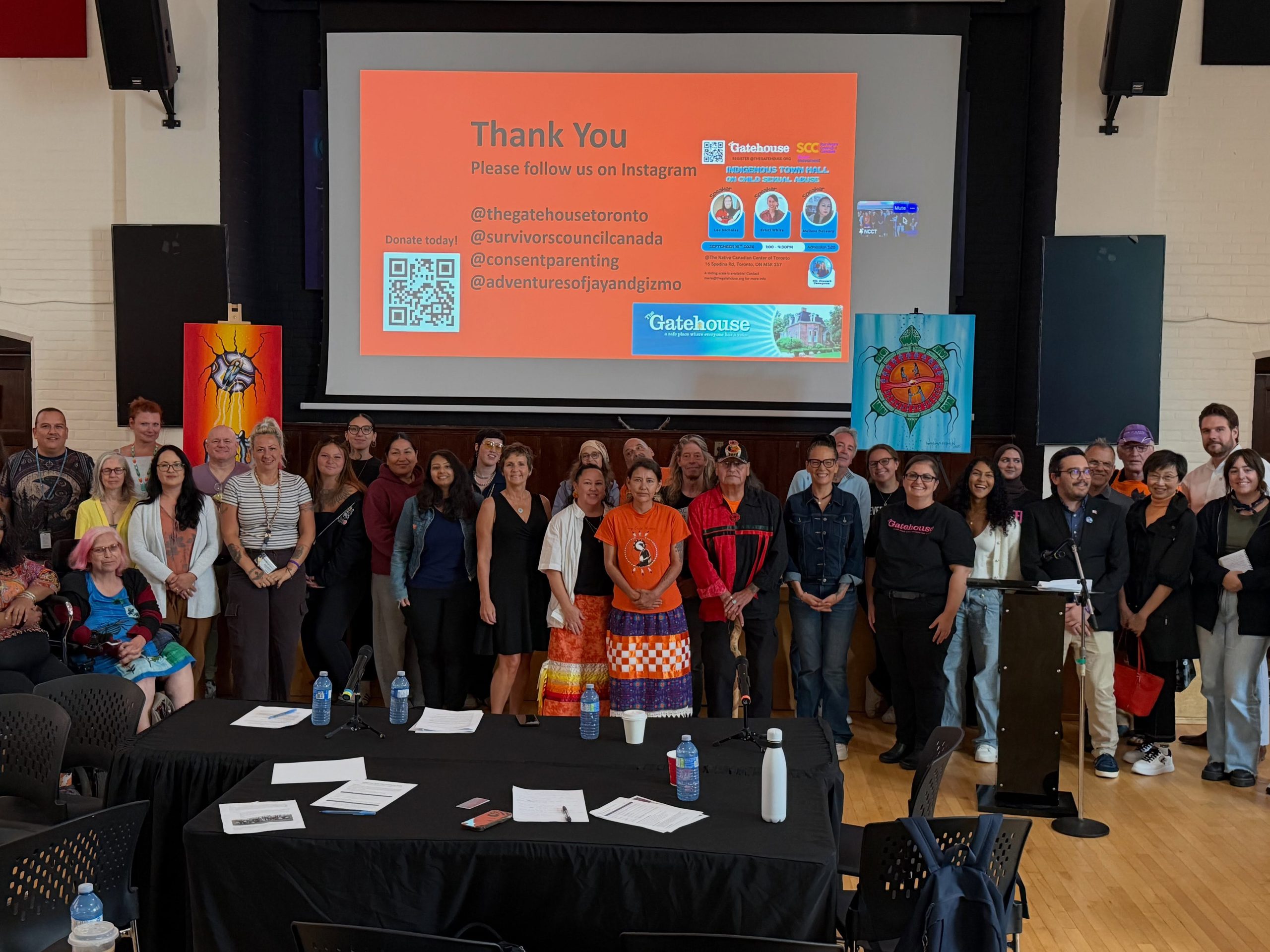
Resilience does not develop in isolation. Everyone is capable of building resilience, and community-based supports play a critical role in this process. Programs such as peer support groups—like those at the Gatehouse—are particularly effective because they create spaces where resilience is modeled, shared, and encouraged.
These groups bring people together, reinforce that survivors’ voices matter, and affirm that everyone is worthy of being listened to, believed, and supported.
Resilience does not develop in isolation. Everyone is capable of building resilience, and community-based supports play a critical role in this process. Programs such as peer support groups—like those at the Gatehouse—are particularly effective because they create spaces where resilience is modeled, shared, and encouraged.
These groups bring people together, reinforce that survivors’ voices matter, and affirm that everyone is worthy of being listened to, believed, and supported.
Resilience does not develop in isolation. Everyone is capable of building resilience, and community-based supports play a critical role in this process. Programs such as peer support groups—like those at the Gatehouse—are particularly effective because they create spaces where resilience is modeled, shared, and encouraged.
These groups bring people together, reinforce that survivors’ voices matter, and affirm that everyone is worthy of being listened to, believed, and supported.
Resilience does not develop in isolation. Everyone is capable of building resilience, and community-based supports play a critical role in this process. Programs such as peer support groups—like those at the Gatehouse—are particularly effective because they create spaces where resilience is modelled, shared, and encouraged.
These groups bring people together, reinforce that survivors’ voices matter, and affirm that everyone is worthy of being listened to, believed, and supported.
Taken together, these findings illustrate how resilience is both an internal process and a relational one—supported by personal coping strategies, belief systems, and physical well-being, while also being deeply influenced by relational support.
A Final Reflection
Resilience is not something people either have or don’t have—it is something that can be nurtured. Through individual strengths, supportive families, and compassionate communities, CSA survivors can build resilience at their own pace and in their own way.
Healing is not linear, but resilience reminds us that growth, connection, and hope remain possible. This is why programs like the ones here at The Gatehouse are integral stepping stones in the healing journey.
Citations
Fostering resilience in survivors of child sexual abuse to decrease vulnerability to sexual revictimization. (2021). CSHR: Child Sexual Harm Review, 3(3), 61.
Porterfield, K. A., & Lindhout, A. (2014). Healing in forgiveness: A discussion with Amanda Lindhout and Katherine Porterfield, PhD.European Journal of Psychotraumatology, 5.