
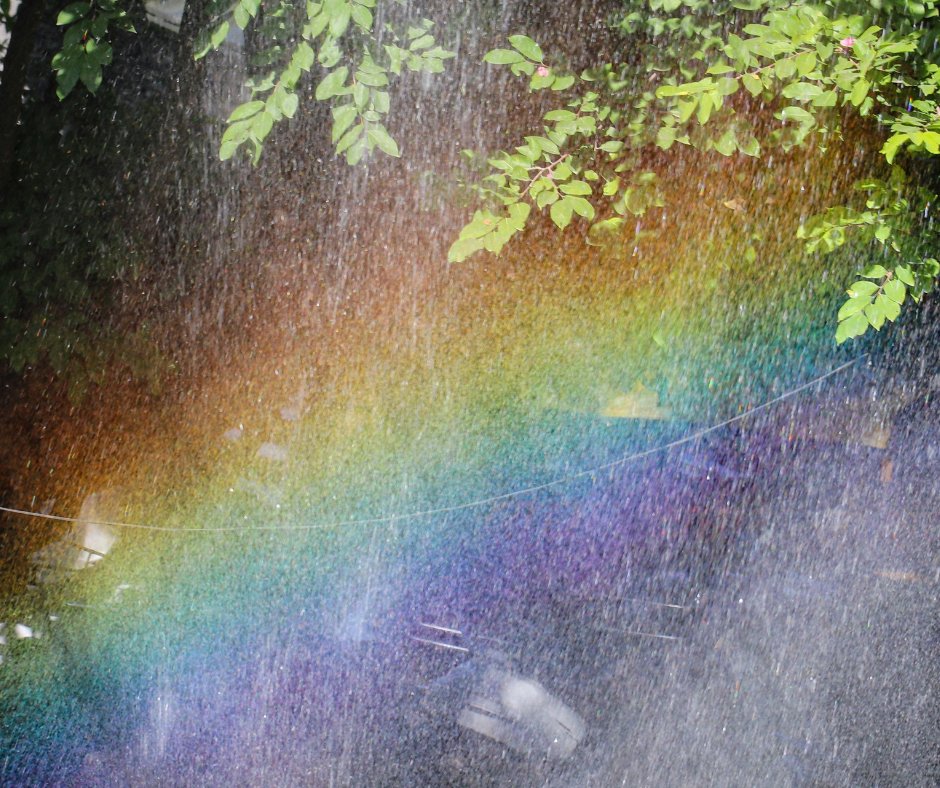
Like an old growth forest, trauma, especially sexual violence, can act like a saw cutting everything down. What once stood tall, lush, and was home to a thriving ecosystem is suddenly gone, leaving us in the aftermath. And yet, with intention and work, even forests can begin again. The work and intention become ours: to replant, to tend, to trust that something can grow back, different, but still alive. Nature doesn’t only show us how things are lost, it shows us how they return, in forms we might not immediately recognize. Regrowth is not separate from the storm; it depends on it. What feels like disruption is often part of a longer cycle of renewal, one that asks for patience, trust, and a willingness to see beyond what is immediately visible. As I walk in the rain, I am reminded that we need it for the earth to remain healthy. Many of us complain about it, but it is a kind of magic in action. Rain doesn’t just fall, it forms over time, through changing conditions, through invisible processes we rarely stop to notice. And when it arrives, it nourishes and cleanses. Some days, it even gives us a rainbow. It is not through perfection that beauty arrives, but through process, through the same rain that nourishes. Rainbows are full circles, though we only ever see a portion of them. It depends on where we stand, the angle of the light, the moment we are in. Each of us is seeing a slightly different part of the whole rainbow. People are like that too. We are constantly changing; we are not static creatures. We see others, and are seen, as we are in a moment in time. When someone misunderstands us, or holds a fixed idea of who we are, they are only seeing one part of the rainbow. And we do the same to others. Recognizing this can create space for understanding and compassion—for ourselves and for each other. No person is only one thing. No one is always angry, or always joyful, always kind, or always unaware. We move through these states; they are moments, not identities. The people we encounter are often meeting just a small segment of ourselves, a passing expression, a single version shaped by that moment. And we are doing the same with them. We can remind ourselves: this is who I am right now, in this moment. And this moment is not infinite. It will shift, as all things do. Or inversely, I am not this person all the time. It’s only one part of my rainbow. Change is inevitable. This can help us move through experiences with more compassion, without excusing harmful behaviour, and decrease our own suffering. Rainbows often appear on rainy days, and in unexpected moments. They are what happens when light moves through a transparent object, slows down, and reveals its component parts. Maybe we are like that too. As we move through pain, we can slow down and begin to see the component aspects of what makes us who we are, all the colors, all the pieces coming into alignment. We were never broken. But we can learn to feel whole again. Reflection Questions

How the Science and Art of Shinrin-yoku Can Support Healing
A Brief History of Shinrin-yoku The term shinrin-yoku was coined in 1982 by Tomohide Akiyama, who was the director of the Japanese Ministry of Agriculture, Forestry, and Fisheries. Several studies were conducted in Japan during the 1980s, and soon forest bathing was seen to be an effective method in destressing and supporting the immune system. Another notable discovery is that compounds like phytoncides and other essential oils in trees and plants have beneficial health effects. Beyond the physiological benefits Shinrin-yoku was also developed as a response to the increasing urbanization and technological advancements in Japan. Forest bathing was implemented to encourage reconnection to nature, and with this reconnection a drive to protect the wild world. What we can see in this is a beautiful cyclical symbiosis occurring: nature supports survivors, and survivors can support nature in return. How Does Shinrin-yoku Connect to Trauma? Trauma can fracture one’s sense of self; open chasms between family and friends; the world becomes frightening full of distrust. The Japanese’ intent to reconnect people with nature mirrors nature’s gentle invitation for survivors to reconnect with themselves. Self-connection encourages survivors to protect themselves through self-compassion, self-validation instead of methods that no longer serve them. Furthermore, the hope for people to want to protect nature is indicative that healing is individual and collective; internal and external, reciprocal. When healing begin so does expansion: moving from within us, to those we love, to community, to the wider world. Like the sun rising, its warm glow slowly expanding over everything below, healing too expands, shining its nurturing light on all that needs it to grow. How Does One Conduct Shinrin-yoku Forest bathing is a melding of mindfulness and meditation enhanced by the inevitable calm of natural spaces. For survivors the slow pace and peaceful sounds can bring our mind-body into a state of calm that has long-lasting effects: “The results of Japanese studies have shown forest bathing improves sleep quality, mood, ability to focus, stress levels. Chronic stress can contribute to the development of ailments like anxiety, depression and insomnia (Forest Bathing in Japan; 2022).” While you may not have access to serene Japanese mountains, local green spaces offer the same benefits. Whether a small park, or a mountain rage, take time to mindfully smell the flowers, the leaves. Rest your palm against the bark of a tree, run your fingers across mossy patches; inhale deeply and notice the smell of air, and dirt. Listen to the distinct chirping of birds, the wind rustling the leaves. Remember you aren’t here to fix or change anything: nature is a place to step outside of pain, expectations, overwhelm for a moment, to just be. Ceremony in Nature If you are interested in bringing ceremony into your outdoors experience, I offer you the following exercise, which you can make as spiritual and ceremonious as you are comfortable this: this is your experience. Begin by naming what you are ready to release: a specific emotion, memory, belief. Use something light and biodegradable like a leaf, flower petal, or a small piece of paper and write a word or symbol on to it. You can also simply place your intention and energy for release into this object. When you find the right spot for you, and the wind begins to stir, let it carry your object however it drifts, falls or floats. Pay attention to what surfaces for you. Honor those feelings. Hold your hand to your heart or place your hand on the bark of a tree, whatever feels right for you, and say silently or aloud that which you are honoring. You are still here. You are on your healing journey. You are safe in this moment. Resources If you would like to hear from one of the modern day leading scientists on Shinrin-yoku you can click on this link and listen to Dr. Qing Li talk about the practice: The Art and Science of Forest Bathing with Dr Qing Li – YouTube Organization, Japan National Tourism. “Forest Bathing in Japan (Shinrin-Yoku): Guide: Travel Japan – Japan National Tourism Organization (Official Site).” Travel Japan, 14 Apr. 2022, www.japan.travel/en/guide/forest-bathing/.